
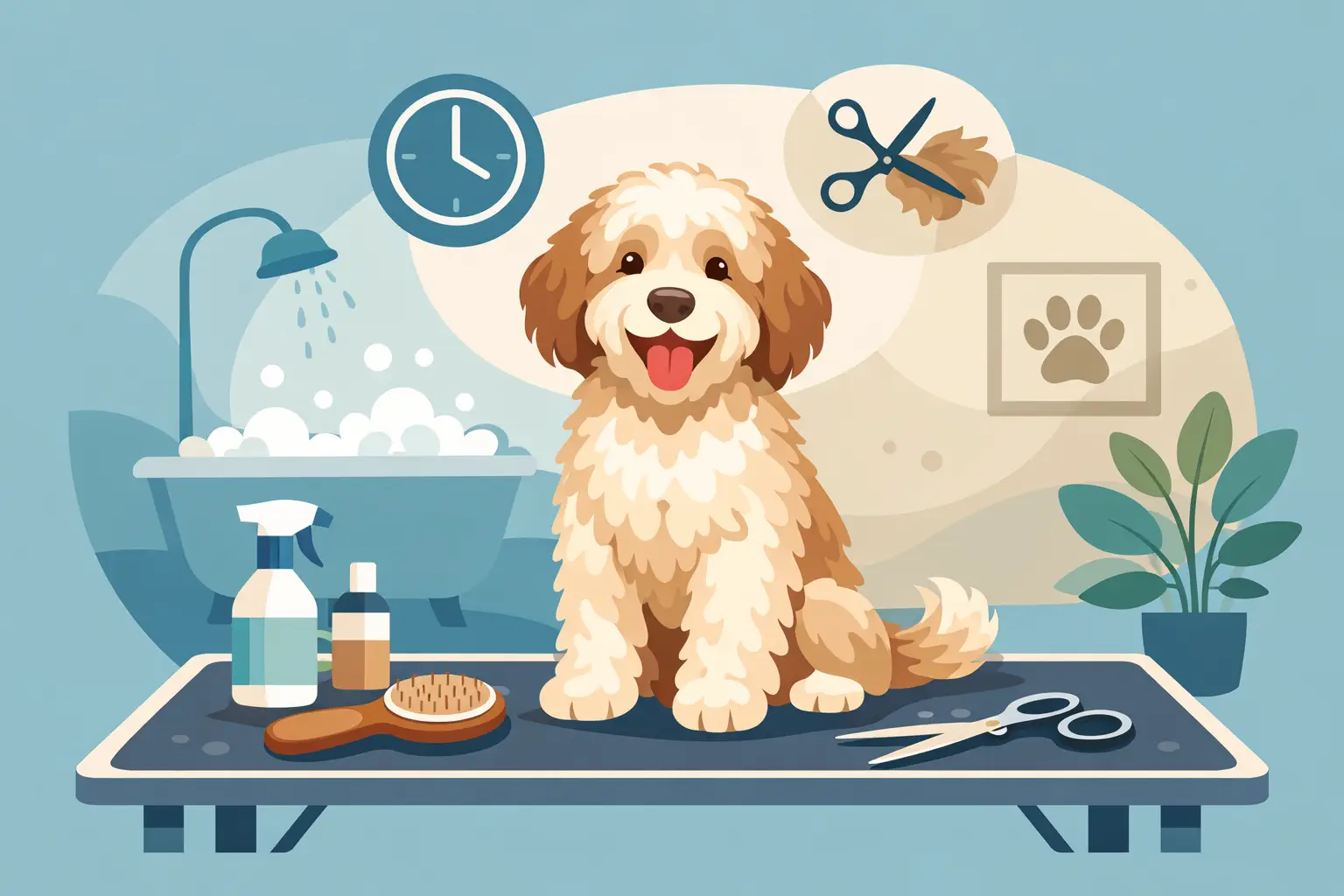
That fluffy, teddy-bear coat is one of the biggest reasons families fall in love with this breed. It is also why so many new owners ask how often groom Australian Labradoodle coats without ending up with tangles, painful mats, or a dog that looks shaggy one week and over-trimmed the next.
The short answer is this: most Australian Labradoodles need brushing several times a week, a bath about every 3 to 6 weeks, and professional grooming every 6 to 8 weeks. But real life is a little more nuanced than that. Coat type, activity level, age, and how long you keep the coat all affect the right schedule.
If you are preparing for your first puppy or trying to set a better routine for your adult dog, the goal is not perfection. The goal is consistency. A steady grooming rhythm keeps your dog comfortable, keeps shedding low, and makes coat care much easier for the whole family.
How often to groom an Australian Labradoodle
When people ask how often to groom an Australian Labradoodle, they are usually talking about more than one thing. Grooming includes brushing, bathing, nail care, ear care, and full haircuts. Each part runs on a slightly different schedule.
For most family pets, brushing should happen at least 3 to 4 times a week. Some coats do well with every-other-day brushing, while longer or denser fleece coats may need daily attention in high-friction areas like the ears, collar line, chest, legs, and tail. If your dog swims often, plays hard outside, or wears a harness daily, you may need to brush more often.
Bathing usually works well every 3 to 6 weeks. Too frequent bathing can dry the skin if you use harsh products or skip conditioner, but waiting too long can lead to buildup, odor, and tangles that tighten after a bath. A clean coat is often easier to brush than a dirty one.
Professional grooming is typically best every 6 to 8 weeks. Some families stretch it to 8 to 10 weeks if they keep the coat shorter and stay on top of brushing at home. Others book every 4 to 6 weeks because they prefer a neater look and want the face, feet, and sanitary areas maintained more often.
Why coat type changes the schedule
Not every Australian Labradoodle coat behaves the same way. Even within the same litter, one puppy may have a looser, easier-care fleece coat while another develops a thicker texture that mats faster.
A wavy fleece coat is often the easiest for families to maintain. It still needs regular brushing, but it usually tangles less quickly than a very dense curly coat. A curlier coat can be beautiful and still low-shedding, but it often requires more frequent line brushing and more dependable professional grooming.
Coat length matters too. A longer teddy-bear trim looks soft and full, but it is less forgiving if your schedule gets busy. A shorter trim can be a very practical choice for active families, especially during warmer months or during a puppy’s coat transition.
That is why there is no single perfect answer for every dog. The better question is not just how often groom Australian Labradoodle coats, but what coat your specific dog has and how much upkeep fits your household.
Puppy coats need a different approach
Puppies are usually easier to brush at first, but that does not mean grooming can wait. Early handling teaches a puppy to accept brushing, nail trims, bathing, and blow drying calmly. That foundation matters just as much as the coat itself.
Most puppies should be introduced to gentle brushing several times a week, even if the coat still seems easy. Keep sessions short and positive. Touch the paws, ears, face, tail, and belly so your puppy learns that grooming is a normal part of family life.
Around 6 to 12 months, many Australian Labradoodles go through a coat change as the soft puppy coat gives way to the adult coat. This is often when matting shows up fast. Families sometimes think they are brushing enough because the coat still looks fluffy on the surface, but tight tangles can hide close to the skin.
During this transition, more frequent brushing is often necessary. This is also when regular professional appointments become especially helpful. An experienced groomer can keep the coat manageable while your puppy adjusts.
What a healthy home routine looks like
A realistic home routine does not need to be complicated. In fact, simple and steady is usually what works best.
Brushing several times a week is the heart of coat care. Focus on brushing all the way to the skin rather than only smoothing the top layer. Areas behind the ears, under the collar, under the front legs, around the hindquarters, and along the legs tend to mat first. If the brush glides over the top but a comb cannot pass through easily, there are tangles forming.
Bathing should include a dog-safe shampoo and, ideally, a good conditioner or detangling product if the coat tends to dry out. Fully drying the coat matters. A damp coat can tighten tangles and create skin issues if moisture sits too long.
Nails usually need attention every 3 to 4 weeks, though active dogs that walk on pavement may wear them down more naturally. Ears should be checked weekly, especially in dogs who swim or have hair growth that traps moisture. Teeth should be brushed regularly too, even though many owners do not think of dental care as part of grooming.
Signs your dog needs more frequent grooming
Sometimes the coat tells you the schedule is not working before you do. If your dog develops small knots behind the ears, under the harness, or near the tail every week, that usually means brushing needs to be more thorough or more frequent.
A dull coat, doggy odor, excessive licking, head shaking, or debris collecting around the eyes can also signal that grooming intervals are too long. If your groomer mentions matting at nearly every appointment, that is not a sign of failure. It is just a sign that the home routine or the haircut length needs to be adjusted.
For many families, the easiest fix is a slightly shorter trim paired with a dependable grooming calendar. A shorter coat does not take away from the breed’s charm. In many cases, it makes the dog more comfortable and easier to maintain.
Professional grooming versus doing it yourself
Many owners do a combination of both, and that is often the best balance. Home care keeps the coat healthy between appointments, while professional grooming handles the detailed trimming, bathing, drying, and finishing work that can be hard to do well at home.
If you plan to manage more grooming yourself, be honest about your schedule and your dog’s tolerance. Brushing a cooperative dog for ten minutes a few times a week is very manageable. Bathing, drying, and clipping a thick coat evenly is a different level of work.
There is also a comfort factor for the dog. Matted coats pull on the skin and can make grooming stressful. Staying ahead of tangles is kinder than trying to work through them after they tighten.
At Providence Hill Australian Labradoodles, one of the most common concerns we hear from families is whether the coat will be manageable in everyday life. The good news is yes, it usually is, as long as expectations are realistic and grooming becomes part of your routine instead of something you save for when the coat looks messy.
The best schedule for most families
If you want a practical starting point, this is the schedule that works well for many pet homes. Brush 3 to 4 times a week, check ears weekly, trim nails every 3 to 4 weeks, bathe every 3 to 6 weeks, and book professional grooming every 6 to 8 weeks.
Then adjust from there. If your dog has a curlier coat, keeps a longer style, or is going through coat transition, move toward more frequent brushing and possibly shorter intervals between grooming appointments. If your dog wears a shorter trim and your home brushing is consistent, you may have a little more flexibility.
What matters most is not chasing a perfect calendar. It is noticing your dog’s coat, skin, and comfort level and responding before small tangles become a bigger problem. When grooming is handled regularly, an Australian Labradoodle’s coat stays soft, clean, and far easier to live with – which is exactly what most families are hoping for when they bring one home.