A puppy may fit comfortably in one arm today, but the adult dog you welcome into your family will need the right amount of room, exercise, and support for years to come. This guide to Australian Labradoodle sizes helps you look beyond a cute puppy photo and understand what mini, medium, and standard sizes can mean for your daily life.
Australian Labradoodles are bred in a range of sizes so families can find a companion that suits their home and lifestyle. Size is not a measure of love, intelligence, or trainability. A well-bred Australian Labradoodle of any size can be affectionate, people-focused, and eager to learn. The best fit comes down to practical details, including your household, activity level, travel plans, and comfort with a larger or smaller dog.
Australian Labradoodle Size Guide: The Three Categories
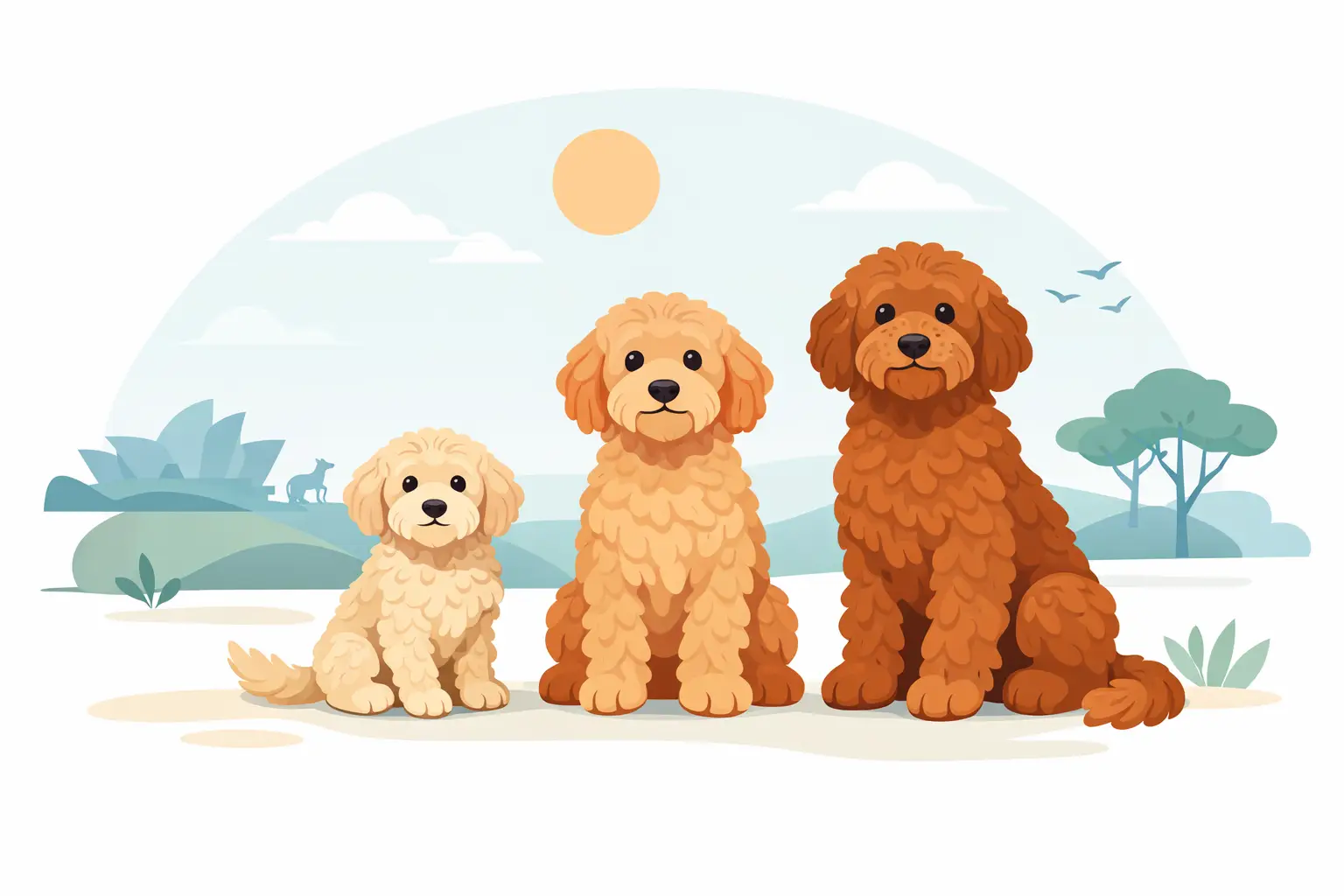
Australian Labradoodle sizes are generally described by the dog’s height at the shoulder, also called the withers. Adult weight provides another useful reference point, although weight can vary based on build, sex, muscle, and overall body condition.
| Size | Typical Adult Height | Typical Adult Weight | | — | — | — | | Miniature | 14 to 16 inches | 15 to 25 pounds | | Medium | 17 to 20 inches | 30 to 45 pounds | | Standard | 21 to 24 inches | 50 to 65 pounds |
These ranges are helpful expectations, not guarantees. Two dogs within the same size category may have noticeably different builds. One medium may be lean and athletic at 30 pounds, while another may have a broader frame and weigh closer to 45 pounds while remaining healthy.
A responsible breeder should be able to discuss the size of a puppy’s parents and the expected adult range for that specific pairing. This is much more meaningful than choosing based on a puppy’s current weight alone.
Mini Australian Labradoodles: Small in Size, Big in Presence
Mini Australian Labradoodles are often appealing to families who want a smaller companion without giving up the friendly, engaging nature that makes this breed so special. At roughly 15 to 25 pounds as adults, many minis are easy to lift when necessary, easier to fit beside you in the car, and comfortable in homes with limited square footage.
A mini can be a wonderful choice for apartment dwellers, retirees, couples, and families who travel frequently. Still, smaller does not mean inactive. Australian Labradoodles are intelligent companion dogs, and a mini needs daily walks, training, play, and time with its people just as much as a larger dog does.
Families with very young children should also consider handling. A small dog can be an excellent family companion, but children need guidance on calm, respectful interactions. Even a sturdy mini should not be carried awkwardly, pulled, or treated like a stuffed animal.
Medium Australian Labradoodles: A Popular Family Balance
Medium Australian Labradoodles often offer the middle ground many families are looking for. Usually ranging from 30 to 45 pounds, they are substantial enough for active family life while remaining manageable for most adults to walk, groom, and travel with.
For households with children, a medium can feel like a particularly comfortable fit. These dogs are often less physically delicate than a mini, yet they do not require the same physical space or lifting ability as a standard. They can join in on neighborhood walks, backyard games, weekend outings, and quiet evenings on the couch.
That said, a medium dog is not automatically the right answer for every family. If your home has tight stairways, frequent air travel, or a resident who may need to lift the dog during an emergency, the difference between 25 and 45 pounds matters. Thinking through those ordinary moments before bringing home a puppy can make the transition easier for everyone.
Standard Australian Labradoodles: More Dog to Love
Standard Australian Labradoodles are the largest of the three categories, commonly standing 21 to 24 inches tall and weighing 50 to 65 pounds. Their size can be especially appealing to families who enjoy a larger companion, have room for a bigger dog bed and crate, or want a dog with a more substantial presence.
A standard Australian Labradoodle can be a lovely choice for an active household. They are often well suited to long walks, outdoor family time, training activities, and simply being close to their people. Their larger frame may also feel more natural for older children who want a dog they can walk and play with under adult supervision.
The trade-off is straightforward: larger dogs cost more to feed, require larger supplies, and are harder to lift or manage physically. A standard needs more room in the car, a larger crate, and a grooming setup that accommodates a bigger dog. These are not reasons to avoid a standard, but they are practical details worth planning for.
What Actually Predicts a Puppy’s Adult Size?
The most reliable starting point is the size of the puppy’s parents. Breeders who carefully plan their litters can usually provide a thoughtful estimate based on the parents’ heights, weights, body structure, and previous puppies from similar lines.
Genetics influences much more than a puppy’s final number on the scale. A puppy may inherit a lighter, athletic build from one parent or a broader build from another. Male and female puppies can differ somewhat in size, but sex alone does not determine where a puppy will fall within the expected range.
Nutrition and overall health also affect how a puppy develops. Puppies need appropriate food and steady growth, not overfeeding in an effort to make them bigger. Keeping a growing dog at a healthy body condition supports developing joints and long-term mobility, especially in medium and standard sizes.
Avoid relying on paw size, a single puppy weigh-in, or comparisons to littermates as a prediction tool. Puppies grow in spurts, and one who is the smallest at eight weeks may not remain the smallest as an adult. Ask about the family line instead.
Size Does Not Determine Temperament or Coat
It is easy to assume that a mini will be calmer or that a standard will be more protective, but size does not reliably predict personality. Temperament is shaped by genetics, early socialization, thoughtful raising practices, training, and the relationship built in the home.
The same is true of coat. Australian Labradoodles are valued by many families for their low-shedding coats, but no dog is completely non-shedding or guaranteed to be suitable for every person with allergies. Coat type, grooming needs, and individual allergy responses should be discussed honestly before choosing a puppy. A smaller dog has less coat overall, but every size still benefits from regular brushing and professional grooming.
How to Choose the Right Size for Your Family
Start by picturing an ordinary weekday, not just the day you bring your puppy home. Consider who will walk the dog, where the dog will sleep, whether your vehicle can comfortably carry an adult dog, and how much help you may need with grooming or travel.
A mini may be ideal if you want a compact companion and can meet its social and exercise needs. A medium often works beautifully for families seeking flexibility and an easy-to-manage adult size. A standard can be a wonderful match if you enjoy a larger dog and are prepared for the added space, feeding, and handling needs.
It also helps to share your priorities openly with your breeder. At Providence Hill Australian Labradoodles, matching is about more than choosing the smallest or largest puppy in a litter. A thoughtful conversation about your family, children, home, schedule, and experience with dogs helps create a better long-term fit.
The right Australian Labradoodle size is the one that lets your future dog be fully included in your life. Choose with the adult years in mind, and you will be better prepared to enjoy every playful, muddy, cuddly moment along the way.